The fastest way to overspend on baseball awards, or to under-whelm a champion, is to shop the catalog before you have decided what each award is actually for. A participation trophy handed to every eight-year-old at the end of a rec season is doing a completely different job than a single championship piece that sits in a league clubhouse for a decade. Once you name the moment first, the size, material, and budget almost pick themselves. This guide walks through the common baseball award occasions and what tends to fit each one, so you can build an order that reads right without guessing.
Start with the occasion, then work backward
Most baseball award orders fall into a handful of recognizable moments. There is the end-of-season handout, where every player on a youth roster gets the same trophy or medal so nobody goes home empty-handed. There is season and team recognition, a modest step up that marks a division title or a strong year. There are individual honors such as MVP, Most Improved, Best Teammate, or a coaches’ award, where you want a piece that clearly stands apart from the participation tier. And there is the champion itself, the tournament or league winner that should look unmistakably like the biggest thing on the table. Sorting your list into those buckets first tells you how many of each you need and roughly how much visual weight each deserves.
The reason this ordering matters is that height and price scale with importance in a way people read instinctively. A table full of identical 8-inch trophies communicates “everyone participated,” which is exactly right for a rec league. A single 24-inch piece next to them communicates “this one is different.” Buy in the reverse order, starting from a style you liked, and you can easily end up with a champion award that barely out-sizes the participation ones, which quietly undercuts the whole point.
The tiers and the heights that read right
Trophy suppliers tend to group finished heights into fairly consistent bands, and those bands map cleanly onto the occasions above. Small trophies in the 6-to-10-inch range are the workhorses for participation and youth recognition. Medium pieces from roughly 10 to 18 inches suit MVP and special individual awards, where you want presence without going oversized. Large trophies from 18 inches up to 36 or more are reserved for championships and grand prizes. Column-style trophies follow the same logic by count: a single column usually lands around 6 to 12 inches, two columns 12 to 18, three columns 18 to 24, and four-column builds run 24 to 36 inches and beyond.
These are indicative ranges rather than hard rules, and a sculpted figure or a tall riser can push any style up a few inches. But they are a reliable starting point when you are trying to picture how a set will look side by side.
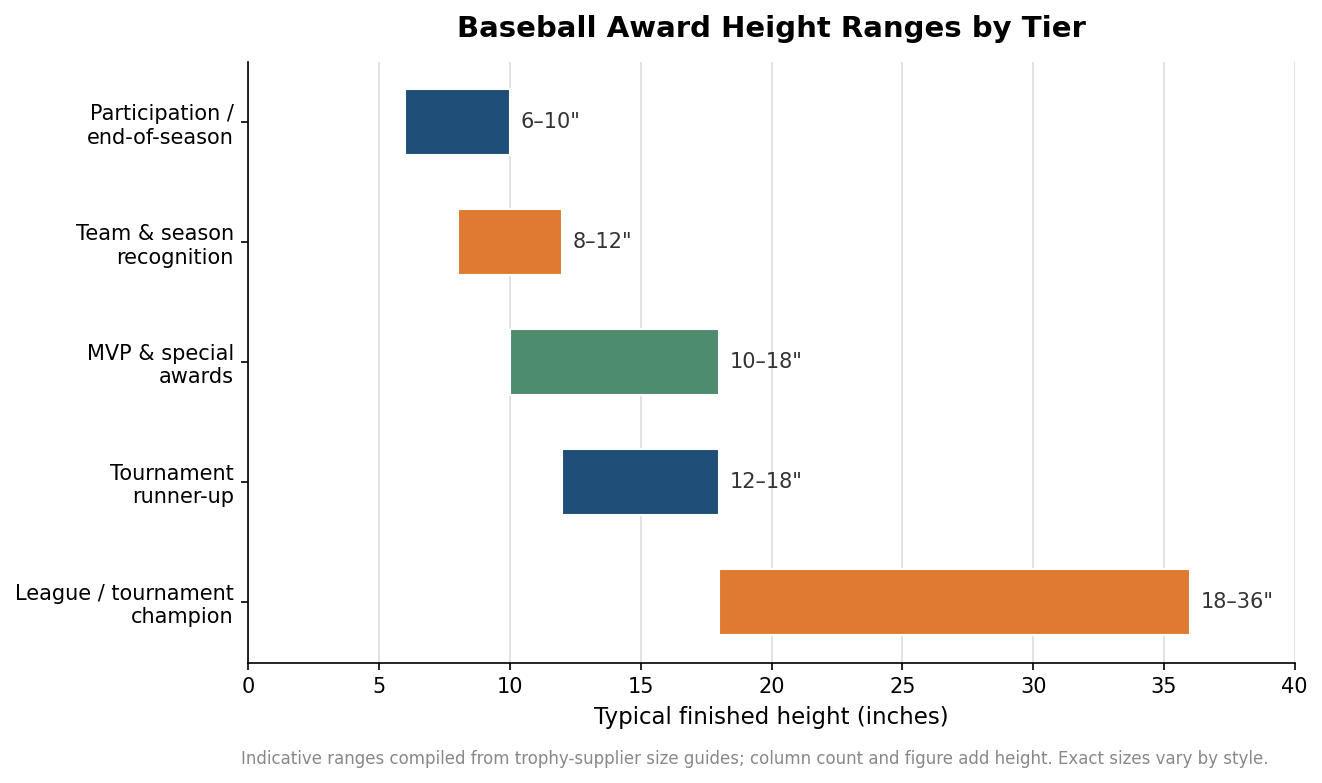
A practical trick: decide the champion’s height first, then step the other tiers down from it. If your league champion piece is 24 inches, an MVP around 14 to 16 inches and participation trophies around 8 inches will create a clear, deliberate hierarchy when they are lined up at the ceremony.
Match the material to the audience and the budget
Material is where the occasion meets the wallet. Resin is the default for youth and team awards for good reason: sculpted resin figures are detailed and durable, they come in every baseball pose imaginable, and they are inexpensive. Across suppliers, stock resin baseball trophies commonly run from under ten dollars to around ninety dollars for large showpieces, with the bulk of practical team options sitting in the mid-teens to about thirty dollars each. Most include a personalized engraved metal plate at no extra charge, which matters when you are ordering a dozen at once.
Acrylic is the lightweight, modern budget option, good for a clean look and custom shapes, and it is often the fastest to produce. Column and metal trophies give you the traditional stacked look and are easy to scale up for bigger winners. Crystal and glass sit at the premium end and are worth reserving for a banquet MVP, a coach’s retirement, or a sponsor gift, where the heft and the engraving quality justify the cost. For a rough budget sanity check, a 12-player roster at fifteen to twenty dollars per trophy lands somewhere around $180 to $240 for the participation tier before you add the standout pieces on top.
Order the set as one system, not a pile of singles
Once you know the tiers and materials, treat the whole order as a coordinated set. Keep the base style and engraving plate format consistent across tiers so the participation trophies and the MVP piece obviously belong to the same event, just at different scales. Standardize your engraving lines early, for example team name, season, and award title, so every plate uses the same layout and nothing looks like an afterthought. Many suppliers apply quantity discounts once you cross a team-sized count, and free ground shipping thresholds are common, so consolidating everything into one order usually beats piecing it together. It also means one proof to approve instead of several, which saves you the most valuable thing of all near an event: time.
Give the calendar the respect it needs
Lead time is the single most common reason awards arrive late, and it is entirely avoidable. Standard, non-rush production typically runs about 5 to 15 business days depending on material, and that is before shipping. Acrylic tends to be quickest at roughly 5 to 10 business days, stock resin falls in the 5-to-15-day band, metal and wood plaques around 7 to 14 days, engraved crystal 10 to 15 days, and fully sculpted or themed custom pieces can take two to four weeks. The quiet delay in almost every order is proof approval; the clock often does not really start until you sign off on the engraving layout.
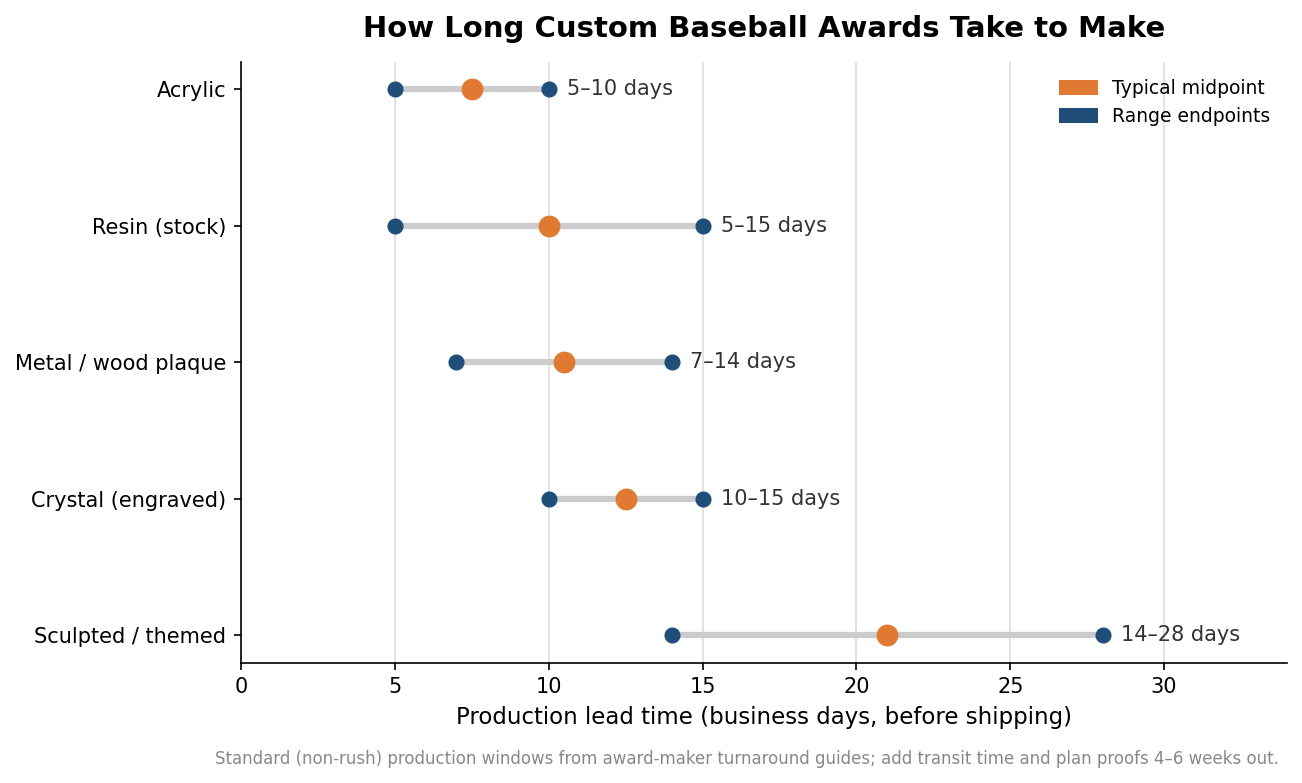
The safe habit is to start the process four to six weeks before the ceremony, especially for larger team orders or anything custom, and to build in a couple of days of buffer for shipping and for a re-proof if a name is misspelled. Rush production is usually available for tighter deadlines, but it typically carries an added fee, so it is a fallback rather than a plan. Order early, approve the proof promptly, and the awards become the easy part of the season instead of the last-minute scramble.
Put together, the method is simple: name the moment, let it set the tier and height, choose a material that fits the audience and the budget, build the whole thing as one coordinated set, and give production the weeks it needs. Do that and every player from the youngest participant to the league champion walks away with an award that feels right for exactly what they earned.