The figure on top gets the attention, but the engraved plate is the part a player rereads years later. It is also the part with the least room for error. Most standard baseball trophy plates give you three lines of roughly 28 characters each, and once a run is engraved there is no editing a typo. Specifying that text carefully, before you approve the order, is the difference between a plate that reads cleanly and one that crowds the edge or drops a kid’s name.
The three lines every plate has to earn
A standard trophy base carries three engraving lines and about 84 characters of usable space. That is less than it sounds once you count spaces, so each line should do exactly one job. The most reliable structure puts the team or league on the top line, the occasion and year on the middle line, and the recipient or the award title on the bottom line. That order reads the way people speak about the award: who gave it, what it was for, and who earned it.
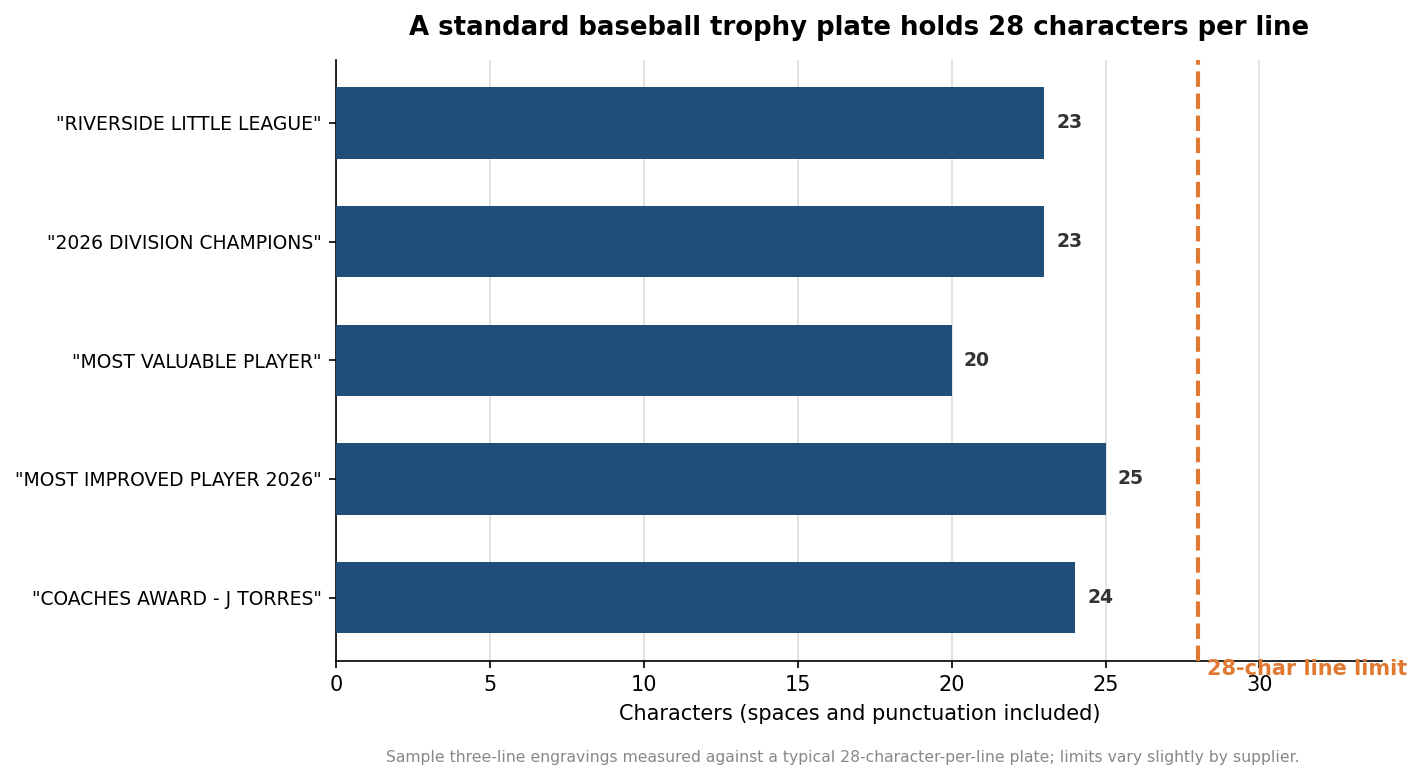
A worked example: RIVERSIDE LITTLE LEAGUE on line one, 2026 DIVISION CHAMPIONS on line two, and MOST VALUABLE PLAYER on line three. Each of those lands comfortably under the character ceiling, which is what you want, because a line that fills all 28 characters leaves no margin if you later correct a spelling or add an initial.
Count the characters before you commit
Spaces and punctuation count against the limit, and that is where wording usually goes wrong. A single line reading MOST IMPROVED PLAYER 2026 is already 25 characters; add a name to the same line and it will not fit. When a line runs long, most shops quietly shrink the font to force it on, which makes that one line look smaller than the others and gives the whole plate an uneven, homemade feel. The fix is simple and entirely in your control: count every line yourself, including spaces, and keep each at or below 28 before you send the order.
Long recipient names are the most common overflow. A name like CHRISTOPHER MARTINEZ-REYES is 26 characters on its own, which fits as a standalone line but leaves no room to share that line with a title. When a name is that long, give it its own line and move the award wording elsewhere.
Wording that survives abbreviation
When a line lands two or three characters over, abbreviate on purpose rather than letting the engraver guess. CHAMPIONSHIP becomes CHAMPIONS or CHAMPS; DIVISION can shorten to DIV where space is tight. Some titles are safe as written: MOST VALUABLE PLAYER is 20 characters and needs no trimming. Award categories that fit cleanly on a single line include MVP, Most Improved Player, Best Teammate, Best Attendance, and the Coaches’ Award, which is why those five show up on so many end-of-season orders. Decide the abbreviation yourself so every plate in the batch reads the same way. If a title simply will not shrink without looking cramped, it is often better to drop it to its own line than to cram two ideas onto one, because an even three-line plate always reads better than a packed two-line one.
Match the plate to the trophy size
Plate size scales with the trophy, so the height you choose quietly sets how much text you can carry. Small awards in the 6- to 8-inch range take a compact plate; plan for shorter lines and fewer of them. A classic 10- to 12-inch column trophy carries the full three-line plate comfortably and is the workhorse size for team awards. A multi-column trophy near 19 inches has room for a larger plate, or a second plate, which matters if you are building a perpetual award that adds a line each season. The figure toppers themselves span roughly 3.25 to 8.75 inches, so a taller trophy is not only about presence, it is also about engraving room. Whatever the size, the 28-character-per-line habit is a safe default that keeps a mixed order looking consistent.
What engraving and quantity actually cost
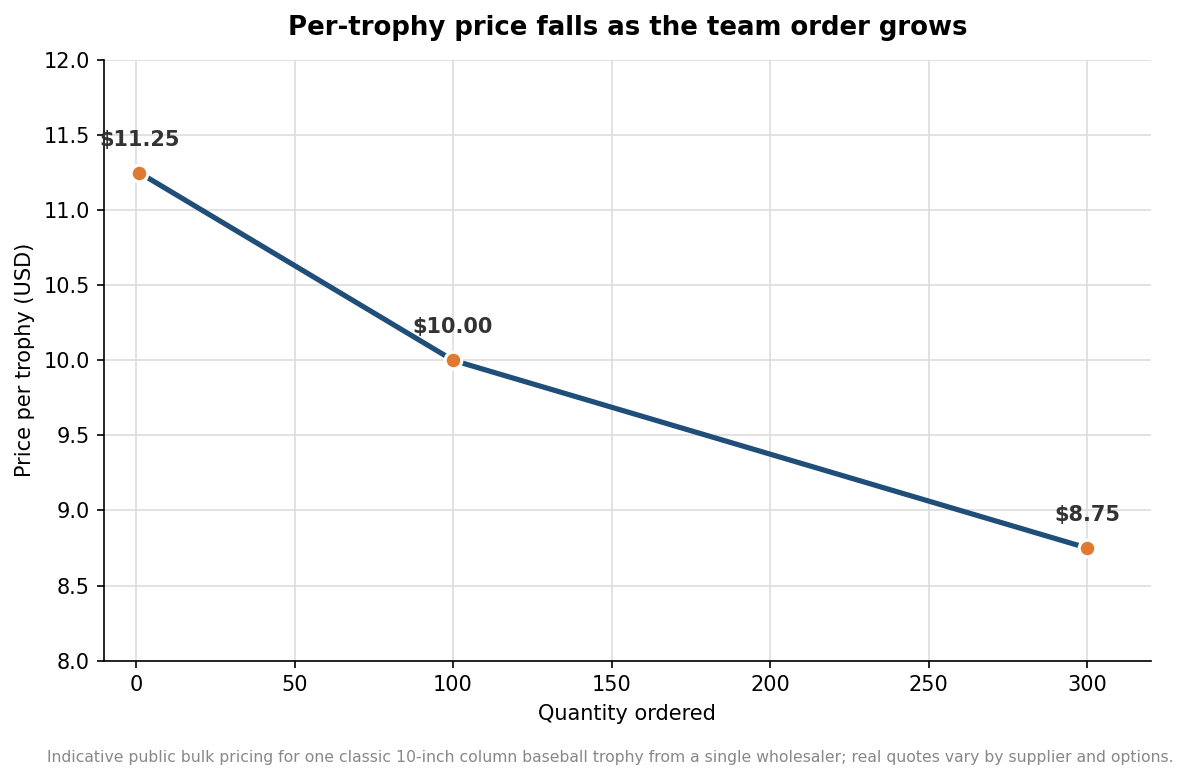
Engraving is frequently bundled in free up to a set number of characters. Forty free letters per trophy is a common threshold, with a modest per-character charge beyond it, so a three-line plate that runs long can carry a small surcharge you would rather know about in advance. The trophy itself is where quantity moves the number. A classic 10-inch column baseball trophy runs around $11.25 as a single unit, eases toward $10 each near 100 pieces, and closer to $8.75 each around 300, based on one wholesaler’s published bulk pricing. Most wholesale tiers start near a $100 order minimum. Those figures are indicative rather than a quote, and options like extra columns, resin figures, or premium plates move them. It is also worth pricing a mix rather than one award for everyone: a taller trophy for the champions and MVP alongside medals or smaller trophies for the rest of the roster often recognizes every player while keeping the total order under control.
Lead times vary by shop and season. In the busy spring and summer stretch, planning on roughly one to two weeks plus engraving time is a reasonable assumption, but treat that as a planning figure and confirm the real date against your banquet, especially if a rush charge is on the table.
Whatever you order, ask for a digital proof of the exact engraving text and read it character by character against your own list before you approve it. Check the spelling of every name, the year, and the spacing, and approve it once. The plate that comes back will be the one a player keeps in a bedroom for a decade, so the ten minutes it takes to count characters and proof the copy is the cheapest quality control on the whole order.